


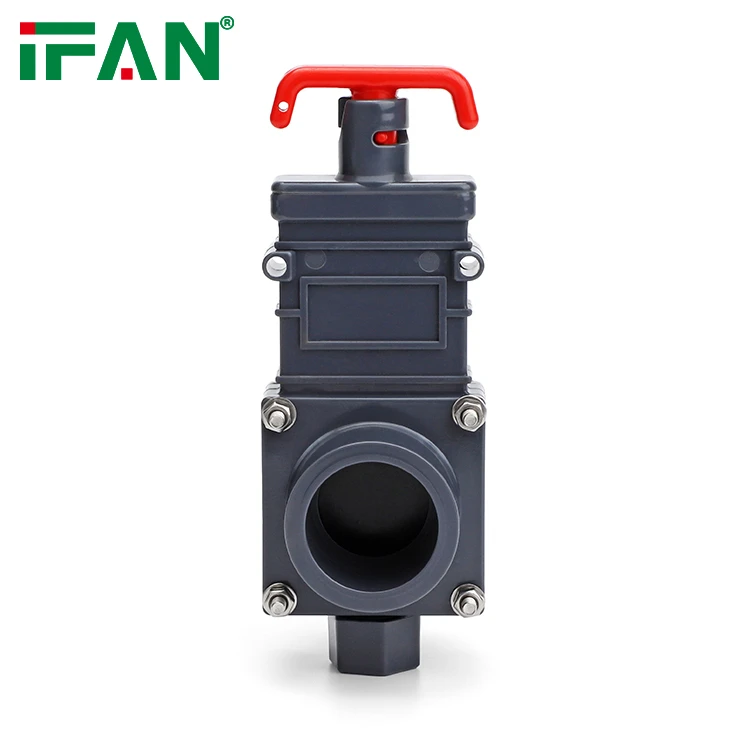
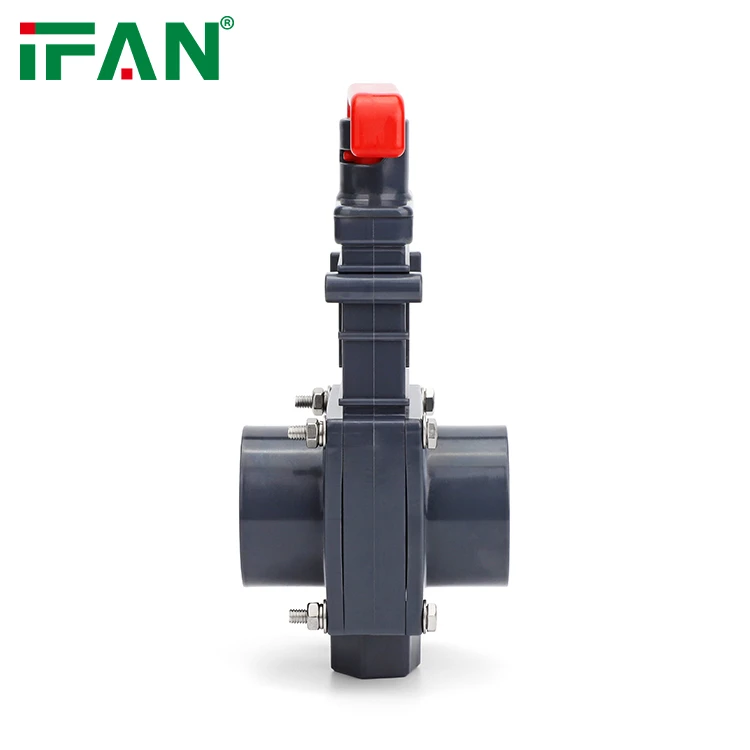
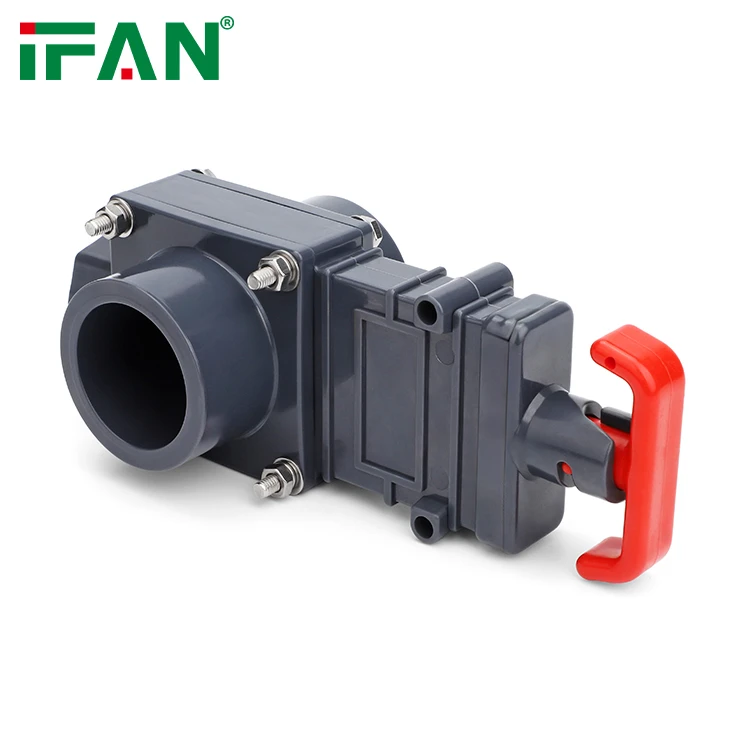
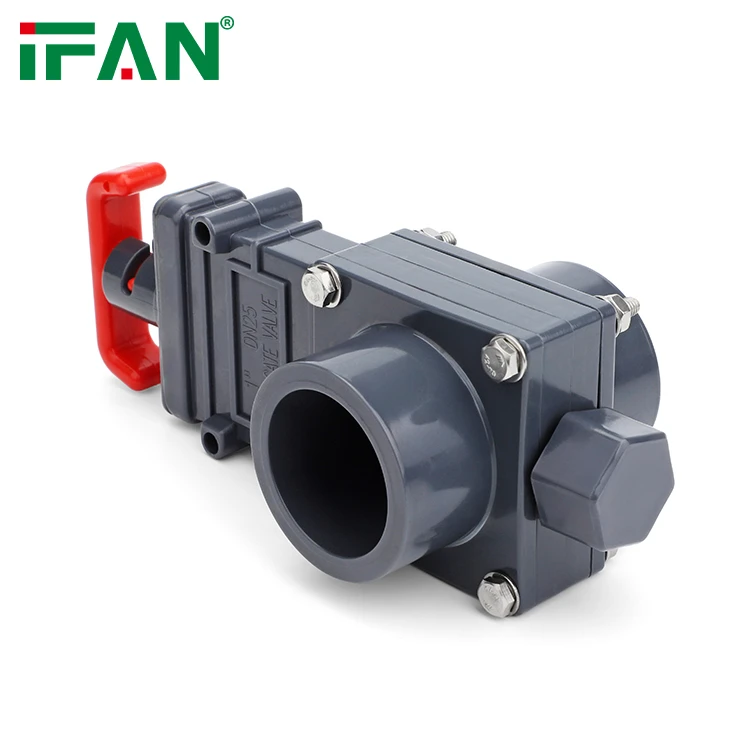
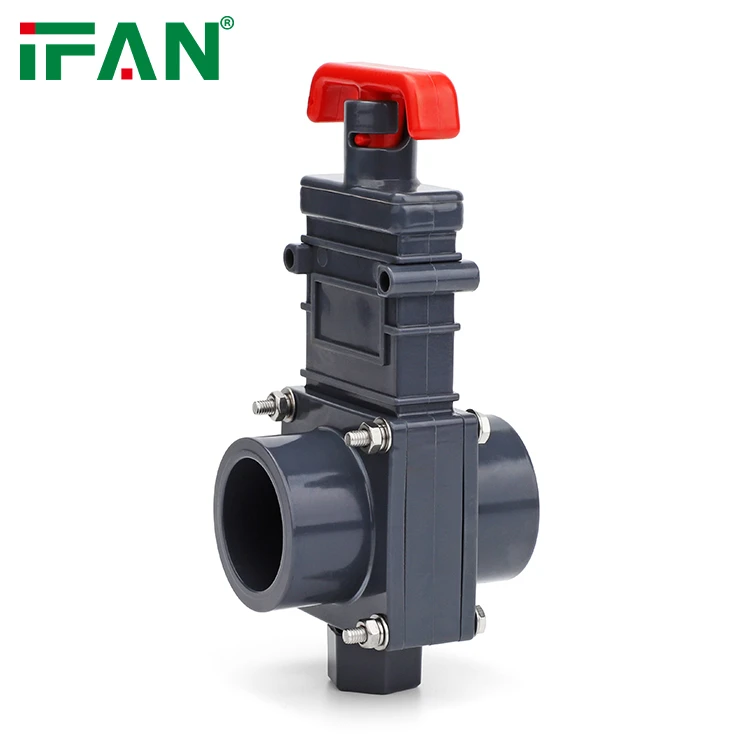
IFAN ISO 4427 PVC Knife Gate Valve
Size: 32-160mm
Color: Gray
Packaging: Carton
The standards we can provide include ASTM D3035, ASTM D3350, ISO 4427 Series standards, EN 12201 Series standards, DIN 8074/8075, GB/T 13663 Series standards, AS/NZS 4130, JIS K6760, BS 6572, CSA B137.1, etc.
PVC Knife Gate Valve: Reliable Flow Control for Corrosive and Solid-Laden Fluids
Introduction
In industrial and commercial piping systems, efficient flow control is essential for safety, performance, and maintenance. Especially in systems handling slurries, powders, or corrosive liquids, the choice of valve can significantly impact operational reliability. For such demanding conditions, the PVC knife gate valve stands out as an effective and durable solution.
This article introduces the PVC knife gate valve in detail, explaining its construction, functionality, key benefits, typical applications, and selection tips. Whether you work in water treatment, mining, agriculture, or chemical processing, understanding the characteristics of this valve can help improve system performance and longevity.
What Is a PVC Knife Gate Valve?
A PVC knife gate valve is a type of shut-off valve designed for on/off service in systems carrying fluids with suspended solids. Unlike traditional valves that use a rotating disc or ball, the knife gate valve uses a flat blade that moves up and down to control flow. As the blade lowers, it cuts through the medium—hence the term “knife”—and seals tightly against the seat.
The body of the valve is made of PVC (polyvinyl chloride), a thermoplastic known for its corrosion resistance, chemical compatibility, and lightweight properties. Compared to metal gate valves, PVC versions are non-reactive, easier to handle, and often more cost-effective, especially in low-pressure and non-extreme temperature applications.
How It Works
To better understand its operation, imagine the valve in a pipeline. In the open position, the blade is fully retracted into the upper housing, allowing free flow through the body. When closed, the blade moves down through the flow path, blocking it completely.
The knife gate mechanism excels in cutting through thick media such as wastewater with sludge, granular flows, or slurry mixtures. The blade is often guided by side grooves and actuated manually using a handwheel or automatically with pneumatic or electric actuators.
Because of its straight-through design, the valve offers minimal pressure drop when open and a tight seal when closed. Moreover, its ability to cut through solids makes it more suitable than globe or ball valves in certain applications.
Construction and Materials
The PVC knife gate valve is made primarily from high-quality industrial-grade PVC. This material offers excellent resistance to corrosion, UV exposure, and chemical attack. It is suitable for use with acids, alkalis, saltwater, and various process chemicals.
The gate or blade is typically made from stainless steel or, in some cases, from plastic-coated metals for added chemical protection. Seals and seats are often made from elastomers such as EPDM or Viton, depending on the chemical compatibility required.
The valve body may be molded as one piece or bolted in two halves, and it includes flanged or wafer-style ends for easy mounting between pipeline flanges. A top-mounted yoke supports the rising or non-rising stem, depending on the design, and houses the actuator mechanism.
This simple yet durable construction minimizes maintenance while ensuring long service life in aggressive environments.
Key Features and Advantages
One of the most notable advantages of the PVC knife gate valve is its resistance to corrosion. In applications where metal valves would degrade quickly, PVC offers long-term reliability. Additionally, its lightweight construction reduces installation labor and cost.
Another major benefit is the valve’s ability to handle media with suspended solids. Whether it is pulp in a paper mill, sludge in a wastewater plant, or sand in a mining operation, the knife gate valve cuts through material that would clog other valve types.
Moreover, PVC is a non-conductive material, making these valves suitable for applications where electrical insulation is required. They are also immune to galvanic corrosion, which can be a concern when connecting dissimilar metals in fluid systems.
Ease of maintenance is another strength. With a simple design and easily accessible parts, most knife gate valves can be disassembled and serviced without removing them from the pipeline.
In addition, the valve is available in various sizes, usually ranging from DN50 (2 inches) to DN300 (12 inches), and can be operated manually, pneumatically, or electrically, depending on user requirements.
Typical Applications
Thanks to their durability and versatility, PVC knife gate valves are used in many industries. Some of the most common applications include:
-
Wastewater treatment: For isolating sections of sludge lines, raw sewage, or chemical dosing lines.
-
Chemical processing: Suitable for non-pressurized or low-pressure systems with aggressive fluids.
-
Mining and mineral processing: Used to handle abrasive slurry mixtures or tailings.
-
Pulp and paper: Ideal for fiber suspensions, pulp stock, and recycled water streams.
-
Food and beverage: In CIP systems and low-pressure non-critical zones.
-
Irrigation and agriculture: For controlling flow in large-diameter irrigation lines or fertilizer mixing tanks.
-
Plastics and powder transport: Effective in dry bulk systems conveying granules or powders.
Because of the valve’s clean shut-off and ability to operate in dirty or viscous media, it is often chosen where clogging and wear are major concerns.
Installation Guidelines
Proper installation is essential to ensure optimal performance of a PVC knife gate valve. First and foremost, the pipeline must be properly aligned to avoid stress on the valve body. Misalignment can lead to leaks or premature wear.
The valve is usually installed between two flanges using gaskets to ensure a tight seal. For wafer-style valves, ensure that the flange bolts are tightened evenly in a crisscross pattern to prevent body distortion.
Manual valves, ensure the handwheel operates smoothly and the stem is lubricated if necessary. For actuated models, confirm that the actuator stroke is properly adjusted so the gate fully opens and closes.
It is also advisable to install the valve in a vertical position with the stem facing upward, especially in systems with heavy or sediment-laden fluids. This prevents debris from settling on the gate and obstructing its movement.
Regular inspection during installation ensures that the blade does not bind and that the seat is clean and properly seated.
Maintenance and Troubleshooting
Although PVC knife gate valves require minimal maintenance, periodic inspection is still recommended. Over time, seals may wear out, and solid particles may accumulate in the body, especially if the valve is left partially open.
To clean the valve, it is often sufficient to flush the system with clean water. For deeper maintenance, the valve can be disassembled by removing the top bonnet and pulling out the blade. Most replacement parts are readily available and easy to install.
If the valve fails to close completely, check for solid debris in the seat area. Leaks around the stem may indicate worn packing or O-rings, which can be replaced without full valve removal.
In automated systems, actuator failure or misalignment may prevent full gate travel. In such cases, checking the actuator settings and performing a manual override can help identify the issue.
With proper care, a PVC knife gate valve can last many years even in aggressive service conditions.
Comparison with Other Valve Types
When selecting a valve, it is important to consider how the PVC knife gate valve compares with alternatives. For example, butterfly valves are compact and economical but may struggle with slurries. Ball valves offer tight sealing but are prone to blockage in solid-laden media. Globe valves provide fine control but are more complex and costly.
In contrast, the knife gate valve offers a unique combination of simple construction, excellent shut-off ability in solid media, and low operating torque. For on/off service in dirty fluids, it is often the most practical choice.
Of course, the decision also depends on pressure ratings, chemical compatibility, flow characteristics, and system design.
Selection Tips
Choosing the right PVC knife gate valve involves several key considerations. First, confirm the chemical compatibility between the fluid and the valve materials, including the body, blade, and seals.
Second, verify that the valve’s pressure rating matches system conditions. PVC valves are typically rated for pressures up to 10 bar, though this may vary with size and temperature.
Next, consider the actuation method. Manual valves are simple and cost-effective, while pneumatic and electric actuators offer remote control and automation for complex systems.
Also, consider how often the valve will cycle. For high-frequency use, selecting a model with reinforced seats and durable stem seals is advisable.
Lastly, check for industry certifications or approvals if required for your project, especially in sectors such as food processing or water treatment.
Environmental and Economic Benefits
The use of PVC knife gate valves also contributes to environmental and economic sustainability. By reducing corrosion and extending service life, they minimize downtime and replacement costs. Their lightweight nature also lowers transportation and installation costs.
Furthermore, their efficiency in handling difficult media reduces product loss and improves process reliability. In water treatment and chemical dosing, for example, accurate shut-off prevents contamination and protects equipment downstream.
Because they require little energy to operate and little maintenance over time, these valves help operators reduce total cost of ownership and environmental impact.
Frequently Asked Questions
-
Can PVC knife gate valves be used for high-temperature applications?
Generally, no. PVC is best for cold to moderately warm fluids, typically up to 60°C (140°F). For higher temperatures, consider CPVC or metal alternatives. -
Are they suitable for vacuum service?
In limited cases, yes. However, they are primarily designed for low-pressure systems and should not be used in high vacuum conditions. -
Do these valves support bi-directional flow?
Most knife gate valves are designed for unidirectional use. Check the manufacturer’s specifications if bi-directional service is needed. -
What maintenance parts are most commonly replaced?
Stem seals, packing, and seats are the most frequently serviced parts. Blades may also be replaced after prolonged use in abrasive environments. -
Can I install a PVC knife gate valve underground?
While possible, it is not recommended without proper access for maintenance. Above-ground installation allows for easier inspection and service.
Conclusion
The PVC knife gate valve represents an ideal flow control solution for systems dealing with corrosive, abrasive, or solid-laden fluids. Its simple structure, excellent sealing capabilities, and chemical resistance make it a smart choice for a wide range of applications.
By understanding its working principle, proper installation methods, and maintenance needs, operators can benefit from long-term reliability and performance. Whether in wastewater treatment, industrial processing, or agricultural irrigation, the PVC knife gate valve delivers dependable shut-off and flow control with minimal cost and complexity.
Contact
With of experience, IFAN is a specialist manufacturer specializing in the production of high quality plastic fittings, fittings and valves. Our products cover copper valves, PPR valves and various fitting and fittingxs to meet different customer needs. No matter what your needs are for plumbing or valves, IFAN offers a wide range of cost-effective products to support your project. Below is our contact information, this is our Whatsapp: +86 19857948982, Email: [email protected]
Related products
-
Sale!
 602 HDPE Compression Fittings
602 HDPE Fittings Elbow
-
 601 HDPE Compression Fittings
601 HDPE Fittings Plug
-
Sale!
 601 HDPE Compression Fittings
601 HDPE Fittings Elbow
-
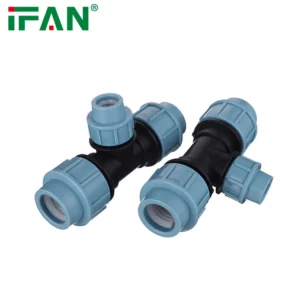 601 HDPE Compression Fittings
601 HDPE Fittings Reduce Tee
-
Sale!
 604 HDPE Compression Fittings
IFANPLUS Factory Direct High Quality 604 HDPE Pipe Fittings Tee
-
Sale!
 604 HDPE Compression Fittings
IFANPLUS Custom Wholesale 604 HDPE Fittings Elbow
-
Sale!
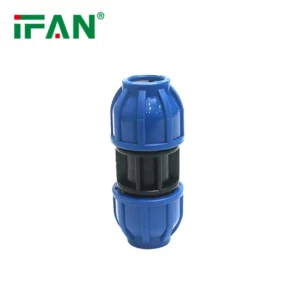 604 HDPE Compression Fittings
IFANPLUS Custom Wholesale 604 HDPE Fittings Socket
-
Sale!
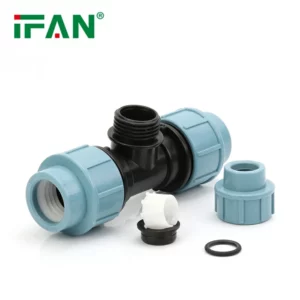 601 HDPE Compression Fittings
IFANPLUS OEM ODM Good Quality PP Fitting Tee