


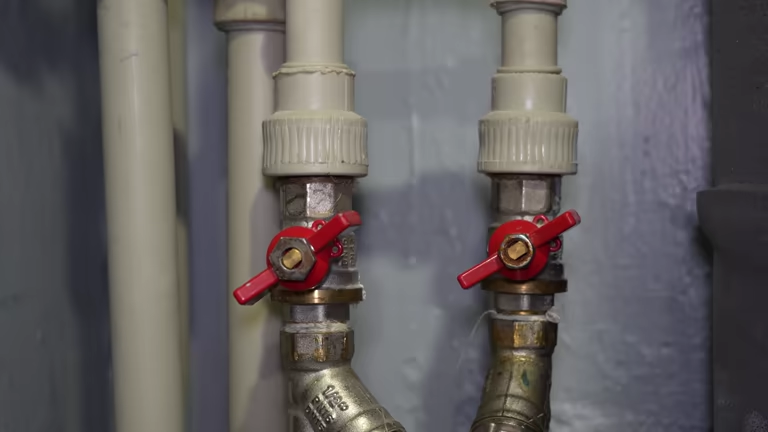
In any water management system, a reliable valve plays a crucial role in maintaining control, safety, and efficiency. Among various valve types, gate valves for water are widely used due to their dependable shut-off capabilities and long service life. However, not all gate valves offer the same performance. Therefore, understanding what makes a good piping gate valve is essential for engineers, contractors, and facility managers alike. This article offers a comprehensive guide on how to identify a quality gate valve, its features, typical applications, selection criteria, and how it compares with other valve types.
Frequently Asked Questions (FAQ)
- What is the function of a gate valve in water systems?
A gate valve controls water flow by raising or lowering a solid gate. It is primarily used to start or stop flow, not to regulate it. - Can gate valves be installed both above and below ground?
Yes. Rising stem valves are typically used above ground, while non-rising stem valves are suitable for underground installations due to their space-saving design. - Are gate valves suitable for potable water systems?
Certainly. When manufactured from certified, non-toxic materials and coated properly, they are safe for drinking water distribution. - Do gate valves require regular maintenance?
They require minimal maintenance. However, occasional inspections, lubrication, and cleaning help extend their lifespan. - What materials are best for gate valves in water systems?
This depends on the specific use case, but commonly used materials include brass, ductile iron, stainless steel, and bronze.
Definition and Key Features of Gate Valves
To begin with, a gate valve is a linear motion valve used to either allow or stop the flow of water. The mechanism involves a gate (or wedge) that moves vertically in and out of the path of the fluid. When fully open, gate valves offer minimal resistance to flow, which makes them highly efficient for systems requiring uninterrupted flow.
Furthermore, their design is relatively simple, which allows for ease of operation and straightforward maintenance. Unlike globe valves or butterfly valves, gate valves operate with a low-pressure drop. This characteristic is especially important in systems that rely on constant and efficient fluid movement.
Key Features Include:
- Full bore flow with minimal restriction
- Tight sealing capabilities when fully closed
- Long-term durability in both cold and hot water conditions
- Availability in a variety of body and stem materials
- Suitability for bi-directional flow
- Manual or automated operation options
These features make gate valves an essential component in many large-scale and localized piping systems.
Common Applications and Use Cases
Gate valves for water are used in numerous sectors. Due to their straightforward design and dependable performance, they fit well in both municipal and industrial settings. Below are some of the most common applications.
Municipal Water Supply
In city water systems, gate valves help isolate specific pipeline sections during repair or maintenance. This isolation prevents full system shutdowns and minimizes service interruptions.
Residential Plumbing
Gate valves are often found at water inlets in homes and buildings. They allow quick shut-off in case of plumbing repairs or emergencies.
Agricultural Irrigation
In farms, irrigation pipelines require flow control across multiple zones. Gate valves provide an effective way to manage water distribution without frequent adjustments.
Industrial Water Networks
In factories and plants, gate valves control cooling water, process water, and wastewater. Because of their durable design, they perform well under varying pressure and temperature conditions.
Firefighting Systems
Many fire suppression systems incorporate gate valves to isolate or redirect water flow quickly. Their quick operation and secure shutoff make them a reliable choice.
Clearly, the broad application range highlights the gate valve’s importance across different sectors.
How to Choose a Good Gate Valve for Water Systems
When selecting a gate valve, several critical factors must be evaluated. These considerations help ensure that the valve will perform efficiently and last long, even in demanding environments.
1. Material Choice
The choice of material directly affects the valve’s durability and corrosion resistance.
- Brass is excellent for residential use, offering corrosion resistance and affordability.
- Cast iron or ductile iron works well for large-scale, buried pipelines.
- Stainless steel resists rust and performs well in high-salinity or chemical-prone water.
- Bronze provides enhanced resistance in marine or acidic conditions.
2. Stem Type
You can choose between rising and non-rising stem valves.
- Rising stem valves provide a visual indication of the open or closed position.
- Non-rising stem valves are space-saving and ideal for confined or underground areas.
3. Seal Design
Gate valves come with either metal-to-metal or resilient (soft) seat seals.
- Resilient seats ensure a tighter shut-off and are common in modern designs.
- Metal seats last longer in extreme temperatures or abrasive environments.
4. Pressure and Temperature Rating
Make sure the valve meets your system’s operational pressure and temperature requirements. These ratings are typically marked on the valve body.
5. Certification
Always check for industry-standard certifications. Valves approved by organizations like NSF, AWWA, or ISO assure you of quality, safety, and compliance.
6. Ease of Maintenance
A good valve allows easy disassembly and repair. Bolted bonnets, accessible internal parts, and replaceable seals contribute to simplified servicing.
By taking these factors into account, you can avoid performance issues and reduce long-term maintenance costs.
What Makes a Good Piping Gate Valve?
So, what truly distinguishes a good piping gate valve from a poor one?
First and foremost, it should offer leak-free shutoff under rated pressure conditions. Secondly, it must be durable, resisting corrosion, wear, and environmental stress. In addition, the valve should allow smooth and precise operation, requiring minimal torque.
Moreover, a well-designed valve ensures compatibility with both horizontal and vertical pipe orientations. It should also comply with regulatory standards and allow for easy inspection and maintenance. Finally, the valve should provide cost-effectiveness through long service life and reduced downtime.
Altogether, these features make a piping gate valve truly reliable for water systems of all sizes.
Comparison: Gate Valves vs. Other Valve Types
To help clarify the strengths of gate valves, let’s compare them with other common water valves.
| Feature | Gate Valve | Ball Valve | Butterfly Valve | Globe Valve |
|---|---|---|---|---|
| Flow Resistance | Very low | Low | Moderate | High |
| Shutoff Performance | Excellent | Excellent | Good | Excellent |
| Suitable for Throttling | No | Limited | Yes | Yes |
| Maintenance Requirements | Low | Low | Low | Moderate |
| Space Requirements | Medium to High | Low | Very low | Medium |
| Common Use | Isolation | Quick shut-off | Compact systems | Flow regulation |
| Cost | Moderate | Moderate | Low | High |
As shown, gate valves excel in isolation applications, offering full bore design with minimal flow loss. However, if flow modulation is required, globe or butterfly valves may be more appropriate.
Conclusion
In conclusion, selecting a good piping gate valve involves more than just matching the size. From material and stem type to certifications and operating environment, many factors influence valve performance and reliability.
Because gate valves for water are commonly used in both small-scale and large-scale systems, it is vital to choose one that offers not only tight shut-off and durability but also ease of use and low maintenance.
Ultimately, when you choose the right valve based on your specific needs, you ensure operational efficiency, safety, and peace of mind for years to come.
Contact IFAN for Catalogs and Samples
Need technical documents, catalogs, or sample products? Reach out to IFAN today.
📧 Email: [email protected]
📱 Whatsapp: +86 19857948982
Our team responds quickly and provides professional support for all your pipeline needs.
IFAN international standard
IFAN piping systems comply with a wide range of international standards to ensure high quality and performance. These include ASTM F1974 and ASTM F1281 for multilayer piping systems, CSA B137 for Canadian plumbing applications, DIN 16836 for German technical specifications, GB18997 for Chinese standards, and ISO 21003, which covers multilayer piping systems used for hot and cold water installations. This broad certification scope highlights IFAN’s commitment to global compliance and product reliability.























