


Introduce
HDPE was created in the 1930s and used in high-frequency radar cables during World War II. It was introduced to the market commercially soon after. While its higher density versions yield a more rigid result, HDPE can vary in flexibility. Low-density grades of the thermoplastic are less stiff and the high-density grades have equally high crystallinity.
High-density polyethylene or HDPE is a commonly used petroleum thermoplastic and the most used of the three polyethylenes for a wide range of applications. If you look at this plastic under a microscope, you would see that it has a linear structure with few branches lending to its optimal strength/density ratio. As a result of its molecular makeup, this polymer shines brightest in applications where moisture resistance and cost-effectiveness are needed.
Properties
Thermophysical properties of high density polyethylene (HDPE)
| Kepadatan | 961 kg/m3 |
|---|---|
| Melting point | 131.8 °C (269.24 °F) |
| Temperature of crystallization | 121.9 °C (251.42 °F) |
| Latent heat of fusion | 188.6 kJ/kg. |
| Thermal conductivity | 0.54 W/m.°C. at °C. |
| Specific heat capacity | 1331 to 2400 J/kg-K |
| Specific heat (solid) | 2.9 kJ/kg. °C. |
| Crystallinity | 61% |
HDPE is resistant to many different solvents, and is exceptionally challenging to glue; joints are typically made by welding.
The physical properties of HDPE can vary depending on the molding process that is used to manufacture a specific sample; to some degree, a determining factor is the international standardized testing methods employed to identify these properties for a specific process. For example, in rotational molding, to identify the environmental stress crack resistance of a sample, the notched constant tensile load test (NCTL) is put to use.
Owing to these desirable properties, pipes constructed out of HDPE are ideally applicable for drinking water and waste water (storm and sewage).
Aplikasi
- Plastic bottles: Most people are informally introduced to the durable plastic through water bottles. HDPE is great for blow-molding applications, particularly food and beverage containers because it won’t leach into the bottles’ contents. In addition, HDPE is recyclable which makes it a great choice for these highly disposable products.
- Toys: HDPE is UV resistant which helps keep the toys resistant to the ray’s damaging and discoloring effects.
- Chemical containers: With its chemical resistant properties, HDPE is great for laundry, shampoo, conditioner, household cleaning products, motor oil, antifreeze and recycling bins. The strength of these bottles is increased when they’ve been colored or pigmented.
- Pipe systems: HDPE pipe grade sheet has a higher molecular weight compared to the standard HDPE used in the above examples. This strengthening with its UV-resistance makes it ideal for piping and outdoor applications. Pipe grade sheet has the ability to withstand -220 to 180 degrees Fahrenheit. It’s durable in most chemical interactions which make it useful in a lot of industrial applications.
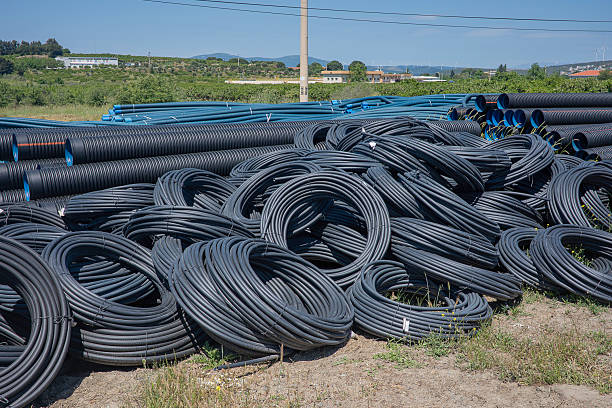
According to Wikipedia, one of the important applications of HDPE is “flexible HDPE pipes.” HDPE’s molecular structure gives it excellent flexibility.
The Advantages of flexible HDPE pipes
Even with its popularity, there are some advantages and disadvantages you should consider before using HDPE for your application:
1.Superior Corrosion Resistance: Rust-free and scale-free, resists corrosion from various chemicals, with a service life of over .
2.Excellent Impact Resistance and Toughness: Highly flexible, able to withstand foundation settlement and external pressure; strong impact resistance; not easily brittle even at low temperatures.
3.Lightweight and Easy to Install: Lightweight, easy to transport and handle; allows for longer coiled installations, reducing joints and significantly lowering installation costs and time.
4.Smooth Inner Wall, High Flow Rate: Extremely low inner wall friction coefficient, high water flow capacity; provides greater water flow for the same pipe diameter and is less prone to sludge buildup.
5.Reliable Connection and Environmentally Friendly: Utilizes heat fusion butt welding to form a seamless piping system, completely eliminating joint leaks. 100% recyclable, environmentally friendly and pollution-free.
IFAN offers a wide range of HDPE pipes and fittings to meet diverse application needs. No matter the size of your order, we can meet your requirements. Contact us via WhatsApp or email below.
Kontak
IFAN adalah produsen profesional dengan pengalaman 30 tahun, yang berdedikasi untuk memproduksi pipa, fitting, dan katup plastik berkualitas tinggi. Produk kami meliputi katup kuningan, katup PPR, serta berbagai pipa dan fitting untuk memenuhi berbagai kebutuhan pelanggan. Baik Anda memerlukan pipa ledeng dan drainase atau produk katup, IFAN dapat menyediakan berbagai macam produk berkualitas tinggi dan hemat biaya untuk mendukung proyek Anda. Berikut adalah informasi kontak kami.
Kami akan membalas email atau faks Anda dalam waktu 24 jam.
Anda dapat menghubungi kami kapan saja jika ada pertanyaan tentang produksi kami.
Untuk informasi lebih lanjut, silakan kunjungi situs web kami https://www.ifanplus.com/
Silakan Kirim Email ke: [email protected]
Telepon Whatsapp: + 86 19857948982
Standar Internasional IFAN
Produk IFAN mematuhi berbagai standar internasional, memastikan keamanan, keandalan, dan kompatibilitas global. Standar-standar ini mencakup ASTM 2846, DIN 8079/8080, ASTM F441/F441M SCH80, berbagai spesifikasi DIN, standar Seri GB/T 18993, AS/NZS 1477, CSA B137.6, NSF/ANSI 14, serta TIS 17-2532/1131-2535. Dengan memenuhi standar-standar yang diakui ini, IFAN menjamin kualitas dan kinerja yang konsisten di berbagai wilayah dan aplikasi.























