


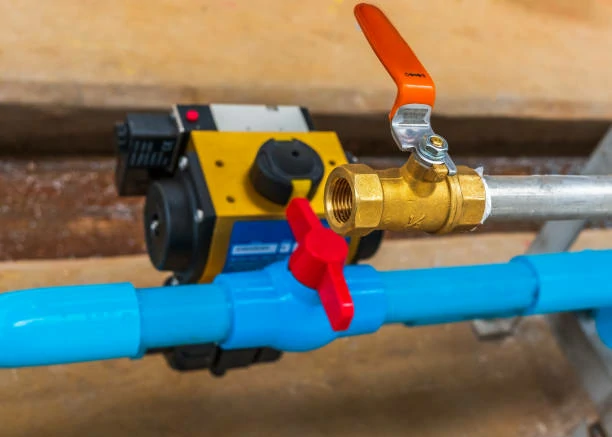
vannes d'eau en PVC play a crucial role in controlling the flow of water in various systems. Whether in residential, industrial, or municipal applications, PVC valves ensure the efficient regulation of water flow. This article will explain the working principles of PVC water valves, how they operate, and their benefits.
1. Overview of PVC Water Valves
A water valve regulates the flow of water through a pipe. It opens, closes, or partially restricts water flow. PVC (Polyvinyl Chloride) water valves are popular because they are durable, cost-effective, and resistant to corrosion. They are used in plumbing, irrigation, and drainage systems.
The working principle of PVC water valves depends on their type and design. Each valve operates by utilizing different mechanisms to control the water flow. Common types include ball valves, gate valves, globe valves, check valves, and pressure relief valves. Let’s explore the working principle of each.
2. Ball Valve Working Principle
Ball valves are one of the most common types of PVC water valves. They consist of a spherical ball with a hole in the middle. This ball is positioned inside the valve body. The valve operates by rotating the ball to either block or allow water flow.
- Open Position: When the valve handle is turned, the ball rotates, aligning the hole with the pipe. Water flows freely through the valve.
- Closed Position: Turning the handle 90 degrees rotates the ball, blocking the hole. This stops the flow of water.
Ball valves are known for their reliability and ease of use. They provide a tight seal, ensuring minimal leakage. They are commonly used for systems requiring frequent on/off operations.
3. Gate Valve Working Principle
Gate valves use a wedge-shaped gate to control water flow. The gate moves up or down inside the valve body, either allowing or blocking water passage.
- Open Position: When the valve handle is turned, the gate rises. Water can flow freely through the valve.
- Closed Position: Turning the handle in the opposite direction lowers the gate, blocking the water flow.
Gate valves are often used when a fully open or fully closed position is needed. They are not suitable for regulating flow, as the gate does not provide precise control.
4. Globe Valve Working Principle
Globe valves use a spherical body with a baffle inside that guides the water flow. These valves provide precise control over water flow, making them ideal for applications requiring throttling.
- Open Position: Turning the handle raises or lowers the disc inside the valve, allowing water to flow through.
- Contrôle de flux: The disc’s position determines how much water passes through the valve. By adjusting the handle, users can control the water flow rate.
Globe valves are often used in systems where water flow needs to be regulated, such as in irrigation or heating systems.
5. Check Valve Working Principle
Check valves prevent backflow in water systems. They allow water to flow in only one direction. When water flows in the desired direction, the valve remains open. When water tries to flow backward, the valve automatically closes.
- Flow Direction: Water flows in one direction, pushing a ball or disc inside the valve. This allows water to pass through.
- Backflow Prevention: If water tries to reverse direction, the ball or disc blocks the opening, preventing backflow.
Check valves are essential in preventing contamination and maintaining pressure in water systems. They are commonly used in plumbing and sewage systems.
6. Pressure Relief Valve Working Principle
Pressure relief valves maintain the pressure within a water system. They open when the pressure exceeds a set limit, allowing water to escape and reducing system pressure.
- Normal Pressure: The valve remains closed under normal pressure conditions, maintaining the integrity of the system.
- Excessive Pressure: When the pressure increases beyond the valve’s preset limit, the valve opens. This allows water to flow out, relieving the pressure.
Pressure relief valves are essential for safety. They prevent damage to pipes, fittings, and equipment caused by excessive pressure.
7. Advantages of PVC Water Valves
The working principle of PVC water valves offers several advantages. These benefits make them ideal for a wide range of applications.
- Résistance à la corrosion: PVC does not corrode, making it ideal for water systems exposed to moisture and chemicals. The material retains its strength and integrity over time.
- Durabilité: PVC water valves can withstand high pressures without deforming. They last longer than many other materials, reducing replacement costs.
- Léger: PVC valves are much lighter than metal valves, making them easier to handle, install, and maintain.
- Rentable: PVC valves are inexpensive compared to metal alternatives. They are affordable, even for large systems.
- Facilité d'entretien: PVC valves require minimal maintenance. They are easy to clean, and their parts are simple to replace if necessary.
8. Applications of PVC Water Valves
PVC water valves are widely used in various industries and residential settings. The simple yet effective working principle makes them suitable for many applications.
- Plomberie résidentielle: PVC valves regulate water flow in household plumbing systems. They ensure that water flows only when needed and at the correct pressure.
- Systèmes d'irrigation: PVC valves control the flow of water to crops or lawns. They ensure an efficient irrigation process, saving water and energy.
- Systèmes industriels: PVC valves are used in factories and manufacturing plants to control water or chemical flow. Their chemical resistance is particularly useful in these settings.
- Traitement des eaux usées: PVC valves control the flow of water in wastewater treatment plants. They help maintain consistent water flow through filtration and treatment processes.
9. How to Choose the Right PVC Water Valve
Selecting the right PVC water valve depends on the specific needs of the system. Factors to consider include:
- Flow Control Needs: For precise flow control, globe valves are ideal. Ball valves work well for simple on/off control.
- Pressure Requirements: For high-pressure systems, ensure the PVC valve is rated for the necessary pressure.
- Résistance à la corrosion: In corrosive environments, choose a valve with high chemical resistance. PVC valves excel in such conditions.
- Taille de la vanne: Choose a valve size that matches the pipe diameter for optimal flow.
- Plage de température: Ensure the valve material can withstand the operating temperature of the system.
10. Conclusion
PVC water valves provide efficient and reliable control of water flow in various systems. Whether used in residential plumbing, industrial applications, or irrigation systems, these valves offer excellent performance. Their working principles, including ball, gate, globe, check, and pressure relief valves, ensure that they can handle different flow control needs. With their corrosion resistance, durability, and cost-effectiveness, PVC water valves are a versatile and valuable choice for modern water systems.
Norme internationale IFAN
Les produits en PEHD d'IFAN sont conformes à diverses normes internationales, garantissant qualité, durabilité et fiabilité. Parmi ces normes figurent les normes ASTM D3035 et ASTM D3350, qui définissent les spécifications des tubes et matériaux en polyéthylène (PE). Les normes ISO 4427 et EN 12201 établissent des références mondiales pour les tubes en PE utilisés dans les réseaux d'approvisionnement en eau. De plus, les normes DIN 8074/8075 et GB/T 13663 établissent les exigences de performance et de dimension des tubes en PEHD sur les marchés européen et chinois. D'autres normes reconnues, telles que AS/NZS 4130 (Australie/Nouvelle-Zélande), JIS K6760 (Japon), BS 6572 (Royaume-Uni) et CSA B137.1 (Canada), témoignent de l'engagement d'IFAN à respecter les réglementations industrielles mondiales.
Contact
IFAN est un fabricant professionnel fort de 30 ans d'expérience, spécialisé dans la production de tuyaux, raccords et vannes en plastique de haute qualité. Nos produits comprennent des vannes en laiton, des vannes en PPR, ainsi que divers tuyaux et raccords pour répondre aux différents besoins de nos clients. Que vous ayez besoin de tuyaux de plomberie et d'évacuation ou de vannes, IFAN propose une gamme diversifiée de produits de haute qualité et économiques pour vos projets. Vous trouverez nos coordonnées ci-dessous.
Nous répondrons à votre e-mail ou fax dans les 24 heures.
Vous pouvez nous appeler à tout moment si vous avez des questions sur notre production.
Pour plus d'informations, veuillez visiter notre site Web https://www.ifanplus.com/
Veuillez envoyer un mail à : [email protected]
WhatsApp : + 86 19857948982























