


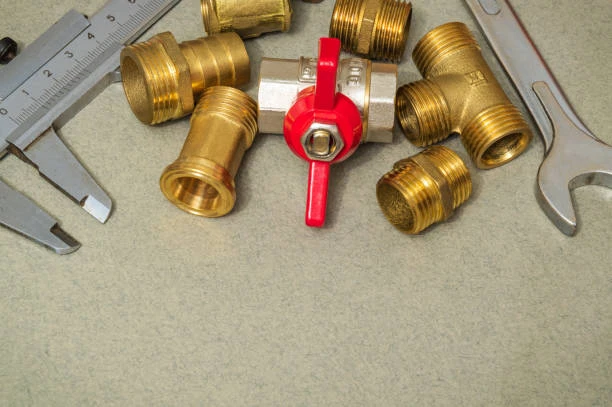
Raccords de plomberie en laiton play a crucial role in modern plumbing systems. Their strength, corrosion resistance, and durability make them a preferred choice for water supply and gas distribution. The manufacturing process of brass plumbing fittings requires precision, high-quality materials, and advanced machining techniques. This article explains each step of the manufacturing process, from raw material selection to final inspection, ensuring optimal product performance.
Sélection des matières premières
Manufacturers use high-quality brass alloys to produce plumbing fittings. Brass consists primarily of copper and zinc, with small amounts of other elements such as lead, aluminum, or silicon. The alloy composition affects the strength, corrosion resistance, and machinability of the fittings.
Suppliers deliver brass in the form of bars, rods, or billets. Before production begins, manufacturers test the raw materials for purity and compliance with industry standards. Chemical analysis and mechanical property tests ensure consistency and performance.
Melting and Casting
Brass billets or rods undergo melting in high-temperature furnaces. The molten metal reaches a precise temperature, preventing impurities from affecting the final product.
After achieving the required temperature, the molten brass moves into casting molds. Manufacturers use different casting techniques, including sand casting, die casting, and continuous casting.
- Sand casting allows the production of complex shapes but requires additional machining.
- Die casting produces fittings with high precision and smooth surfaces.
- Continuous casting ensures uniform material properties and reduces waste.
Once the metal solidifies, the cast pieces undergo cooling before moving to the next stage.
Forming and Shaping
Brass fittings require additional forming processes to achieve their final shape. Different shaping techniques help create threads, bends, or custom designs.
- Hot forging involves heating the brass pieces and pressing them into molds under high pressure. This method increases strength and ensures uniformity.
- Usinage CNC provides precise cuts and threads, improving dimensional accuracy.
- Extrusion forces heated brass through a die, creating uniform pipes or complex profiles.
Each forming method depends on the design and application of the fitting.
Threading and Machining
After forming, brass fittings require threading to connect with pipes securely. Manufacturers use threading machines or CNC lathes to cut precise threads according to standard specifications.
- Internal threading prepares the fitting to receive a pipe.
- External threading allows the fitting to connect with another component.
Besides threading, additional machining processes ensure a smooth surface finish. Drilling, milling, and polishing remove imperfections and enhance performance.
Annealing and Heat Treatment
Brass fittings undergo heat treatment processes to improve strength and durability. Annealing involves heating the fittings to a controlled temperature and then cooling them gradually. This process:
- Reduces internal stresses
- Enhances corrosion resistance
- Improves mechanical properties
Some fittings require quenching or tempering to achieve specific hardness levels.
Surface Treatment and Coating
Brass fittings need protection against oxidation and tarnishing. Manufacturers apply surface treatments to extend lifespan and maintain appearance. Common treatments include:
- Nickel or chrome plating to enhance corrosion resistance
- Polishing to improve aesthetics
- Passivation to remove surface contaminants
Some fittings receive specialized coatings to prevent lead leaching or improve antimicrobial properties.
Contrôle de la qualité et inspection
Every brass fitting undergoes rigorous quality control tests before reaching the market. Manufacturers inspect:
- Dimensional accuracy using precision measuring tools
- Thread quality through thread gauges
- Résistance aux fuites using pressure tests
- Résistance à la corrosion with accelerated aging tests
Non-destructive testing methods, such as X-ray inspection and ultrasonic testing, help detect internal defects.
Emballage et distribution
After passing quality control, brass fittings receive proper packaging to prevent damage during transportation. Bulk packaging suits large-scale projects, while individual packaging meets retail needs.
Manufacturers label each fitting with specifications, batch numbers, and compliance certifications before shipping them to distributors, wholesalers, and plumbing professionals worldwide.
Conclusion
The manufacturing process of brass plumbing fittings involves multiple precise steps, from raw material selection to final inspection. Each stage ensures the fittings meet industry standards and perform reliably in plumbing systems. Advanced machining techniques, strict quality control, and surface treatments contribute to the durability and efficiency of brass plumbing fittings. Understanding this process helps professionals choose high-quality fittings for various plumbing applications
Norme internationale IFAN
Les produits IFAN sont conformes à un large éventail de normes internationales, garantissant leur qualité, leur fiabilité et leur adéquation à diverses applications dans le monde entier. Ces normes incluent notamment les normes ASTM D3035, ASTM D3350, les normes ISO 4427, EN 12201, DIN 8074/8075, GB/T 13663, AS/NZS 4130, JIS K6760, BS 6572 et CSA B137.1. Le respect de ces normes garantit que les produits IFAN répondent aux exigences strictes de sécurité, de performance et de durabilité de divers secteurs et marchés.
Contact
IFAN est un fabricant professionnel fort de 30 ans d'expérience, spécialisé dans la production de tuyaux, raccords et vannes en plastique de haute qualité. Nos produits comprennent des vannes en laiton, des vannes en PPR, ainsi que divers tuyaux et raccords pour répondre aux différents besoins de nos clients. Que vous ayez besoin de tuyaux de plomberie et d'évacuation ou de vannes, IFAN propose une gamme diversifiée de produits de haute qualité et économiques pour vos projets. Vous trouverez nos coordonnées ci-dessous.
Nous répondrons à votre e-mail ou fax dans les 24 heures.
Vous pouvez nous appeler à tout moment si vous avez des questions sur notre production.
Pour plus d'informations, veuillez visiter notre site Web https://www.ifanplus.com/
Veuillez envoyer un mail à : [email protected]
WhatsApp : + 86 19857948982























