


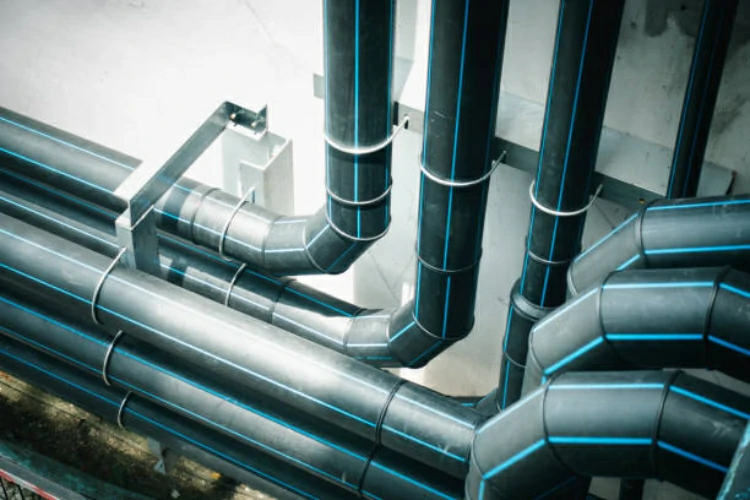
HDPE plumbing systems are renowned for their durability, flexibility, and resistance to corrosion. Let’s delve into the intricate manufacturing process that ensures these pipes meet the highest industry standards.
Sélection des matières premières
The manufacturing journey of HDPE plumbing begins with the careful selection of raw materials. High-density polyethylene (HDPE) resin, known for its strength and chemical resistance, serves as the primary component. Additives such as antioxidants, UV stabilizers, and processing aids are meticulously chosen to enhance the material’s properties and performance.
Procédé d'extrusion
The HDPE resin undergoes the extrusion process, melting and forming it into a continuous profile. It passes through a die, shaping it into pipes of different diameters and thicknesses. This process maintains uniformity and consistency in the dimensions and properties of the pipes.
Coiling and Cutting
Once extruded, the HDPE pipes are cooled and then coiled onto reels for easy transportation and storage. Advanced cutting machinery precisely cuts the coiled pipes into specific lengths according to customer requirements. This step ensures that the pipes are ready for installation without any further processing.
Contrôle de qualité
Quality control remains paramount throughout the manufacturing process. Manufacturers implement rigorous testing procedures to assess the physical, mechanical, and chemical properties of the HDPE pipes. These tests encompass dimensional checks, burst tests, pressure tests, and evaluations for material homogeneity. Any pipes failing to meet the specified standards undergo identification and disposal to uphold the quality of the final product.
Advantages of HDPE Plumbing
The manufacturing process of HDPE plumbing pipes ensures several key advantages:
- Durabilité: HDPE pipes are highly resistant to corrosion, abrasion, and chemical attack, ensuring long-term reliability in various applications.
- Flexibilité: The inherent flexibility of HDPE allows for easier installation, especially in challenging terrain or areas with seismic activity.
- Léger: HDPE pipes are lightweight, making transportation, handling, and installation more convenient and cost-effective.
- Joints étanches: Heat fusion welding creates seamless, leak-free joints, eliminating the risk of water loss or contamination.
- Respectueux de l'environnement: HDPE is a recyclable material, contributing to sustainability efforts and reducing environmental impact.
Conclusion
The manufacturing process of HDPE plumbing pipes involves careful selection of raw materials, precise extrusion techniques, and rigorous quality control measures. These steps ensure that HDPE pipes meet the highest standards of durability, flexibility, and reliability, making them an ideal choice for various plumbing applications.
Contact
IFAN Fort de 30 ans d'expérience, nous sommes un fabricant professionnel de tuyaux, raccords et vannes en plastique de haute qualité. Nos produits comprennent des vannes en laiton, des vannes en PPR, ainsi que divers tuyaux et raccords pour répondre aux différents besoins de nos clients. Que vous ayez besoin de tuyaux de plomberie et d'évacuation ou de vannes, IFAN Nous proposons une gamme diversifiée de produits de haute qualité et économiques pour soutenir vos projets. Vous trouverez ci-dessous nos coordonnées.
Nous répondrons à votre e-mail ou fax dans les 24 heures.
Vous pouvez nous appeler à tout moment si vous avez des questions sur notre production.
Pour plus d'informations, veuillez visiter notre site Web https://www.ifanplus.com/
Veuillez envoyer un mail à : [email protected]























