


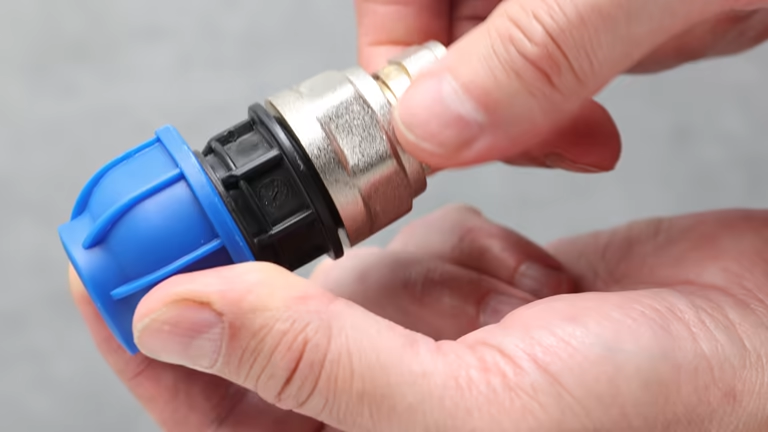
Polyethylene (PE) pipe fittings have gained widespread popularity in modern piping systems due to their excellent material characteristics. These fittings are crucial for connecting PE pipes in various applications, such as water supply, gas distribution, agricultural irrigation, and industrial piping. Understanding the unique material properties of PE pipe fittings helps engineers, contractors, and decision-makers select the right components for optimal system performance.
High Flexibility
First and foremost, one of the most notable features of PE pipe fittings is their high flexibility. Unlike rigid materials such as PVC or metal, PE offers a degree of elasticity that allows the fittings to bend under pressure. Consequently, this property minimizes the risk of cracking or breaking under stress.
Moreover, the flexibility of PE fittings allows for easier installation in challenging terrains. For example, in areas with uneven ground or slight movements, flexible fittings can absorb shifts without causing leaks. This is especially useful in seismic zones, where the ground may shift unexpectedly.
Excellent Chemical Resistance
In addition to flexibility, PE pipe fittings exhibit superior chemical resistance. They are capable of withstanding a wide range of chemicals, including acids, bases, and various solvents. As a result, they are widely used in industrial applications that involve corrosive substances.
Furthermore, PE does not corrode or react with water, making it an ideal material for potable water systems. The inert nature of polyethylene ensures that no harmful substances leach into the water, maintaining water purity and safety for consumers.
High Impact Strength
Another critical advantage of PE pipe fittings lies in their high impact strength. This material can absorb external forces without cracking or fracturing. In contrast, more brittle materials such as clay or concrete tend to fail under sudden impact.
Because of this, PE fittings are commonly used in underground installations where heavy loads or accidental impacts are possible. For instance, construction equipment operating near buried pipelines poses a risk of collision, but PE fittings are more likely to withstand such incidents without damage.
Long Service Life
PE pipe fittings also offer an exceptionally long service life, often exceeding under normal operating conditions. This durability is attributed to their resistance to environmental stress cracking, abrasion, and UV degradation when properly protected.
Additionally, the long lifespan of PE fittings significantly reduces maintenance costs over time. Since fewer replacements are needed, the total cost of ownership decreases, making it a highly economical choice for long-term projects.
Lightweight and Easy Handling
Equally important, PE pipe fittings are lightweight, which simplifies transportation, storage, and installation. Compared to metal or concrete fittings, PE components are much easier to handle, reducing labor requirements and installation time.
This ease of handling also enhances safety at job sites. Workers face fewer risks when maneuvering lighter components, which can help reduce workplace injuries and project delays.
Excellent Thermal Properties
Beyond mechanical properties, PE pipe fittings offer remarkable thermal performance. They maintain integrity across a wide range of temperatures, typically from -40°C to 60°C. Thus, they perform reliably in both cold and hot climates.
In cold weather, their flexibility and resistance to cracking are particularly valuable. Unlike some materials that become brittle in freezing temperatures, PE remains ductile. Consequently, it is often the preferred choice in frost-prone regions.
Low Friction Coefficient
Moreover, PE fittings have a low friction coefficient due to their smooth inner surfaces. This results in minimal pressure loss and efficient fluid flow throughout the system. The smoother surface also reduces the likelihood of clogging or scaling.
As a result, the system operates more efficiently, conserving energy and reducing operational costs. This is especially beneficial in large-scale systems such as municipal water distribution or industrial fluid transport.
Resistance to Biological Growth
Another noteworthy characteristic is the resistance of PE to biological growth. Algae, fungi, and bacteria find it difficult to adhere to or grow on PE surfaces. This ensures that the internal surfaces of the fittings remain clean and hygienic over time.
This hygienic quality is crucial in food processing, pharmaceutical, and drinking water applications, where contamination must be avoided at all costs. Therefore, PE fittings are often the first choice in such sensitive environments.
Non-Toxic and Environmentally Friendly
From an environmental perspective, PE pipe fittings are non-toxic and recyclable. They are manufactured without harmful additives and are safe for use in systems involving human consumption. Moreover, at the end of their useful life, PE fittings can be recycled into new plastic products.
Thus, their environmental footprint is significantly lower than that of metal or cement-based alternatives. Increasingly, sustainability is a key factor in material selection, and PE fittings align well with green construction principles.
Compatibility with Fusion Welding
A major advantage of PE material is its compatibility with fusion welding techniques. Electrofusion and butt fusion are commonly used to create strong, leak-free joints between PE pipes and fittings. These methods effectively create a monolithic pipeline with no weak points.
In contrast, traditional mechanical joints are more prone to leaks and failures. Fusion-welded PE fittings enhance the integrity and reliability of the entire system, which is particularly important in high-pressure or critical applications.
Resistance to Abrasion
In applications involving abrasive fluids or solids, PE pipe fittings also offer outstanding abrasion resistance. Their tough surface withstands wear and tear, even when transporting slurry, sand-laden water, or chemical solutions.
Therefore, industries such as mining, dredging, and chemical processing benefit greatly from PE fittings. While other materials may degrade quickly under similar conditions, PE maintains its performance over time.
Dimensional Stability
Although flexible, PE pipe fittings also maintain excellent dimensional stability under normal pressures and temperatures. This means they retain their shape and size over long periods, which is essential for maintaining system integrity.
Furthermore, PE fittings do not deform or warp when exposed to moderate temperature variations. This characteristic ensures a reliable connection with mating pipes and components, minimizing the need for maintenance or repair.
Resistance to UV Radiation (with Protection)
On their own, PE pipe fittings have limited resistance to ultraviolet (UV) radiation. However, by adding carbon black or other stabilizers during manufacturing, their UV resistance improves dramatically.
As a result, PE fittings designed for outdoor use can withstand sunlight exposure for extended periods. This makes them suitable for irrigation systems, solar water lines, and other open-air applications.
Cost-Effective Material
In terms of economics, PE fittings are highly cost-effective. Although the initial purchase price may be comparable to other materials, the overall lifecycle cost is often much lower. Their longevity, low maintenance requirements, and easy installation all contribute to cost savings.
Additionally, because PE is widely available and easy to manufacture, supply chains remain stable, and prices are generally predictable. This makes budgeting and planning easier for contractors and developers.
Minimal Water Hammer Effect
Due to the flexible nature of PE, fittings made from this material help reduce the water hammer effect. Water hammer is a pressure surge caused when a fluid in motion is forced to stop suddenly. In rigid systems, this can cause significant damage.
However, PE fittings absorb some of the shock, thereby reducing vibration and prolonging system life. This makes PE an ideal material for dynamic systems where pressure changes frequently.
Smooth Installation Process
As mentioned earlier, the installation process for PE fittings is straightforward. Fusion welding techniques ensure reliable joints, and their light weight reduces the need for heavy machinery. In trenchless applications, PE fittings also adapt easily to directional drilling methods.
In many cases, PE systems can be installed faster than systems using traditional materials, helping contractors meet deadlines and reduce labor costs.
Versatile Applications
PE pipe fittings are versatile and suitable for a wide range of applications. Whether in residential plumbing, industrial wastewater systems, agricultural irrigation, or gas distribution, PE performs consistently well.
Moreover, with different pressure ratings and sizes available, the fittings can be tailored to meet specific project needs. This adaptability further enhances the material’s appeal in diverse industries.
Compliance with International Standards
Finally, PE pipe fittings are designed to meet international quality and safety standards. This includes ISO, ASTM, and EN standards that govern everything from material composition to pressure ratings and fusion techniques.
Compliance ensures that systems built with PE fittings meet regulatory requirements and perform reliably over time. It also facilitates global trade and project collaboration across regions.
Conclusion
In conclusion, PE pipe fittings offer a unique combination of flexibility, chemical resistance, durability, and cost-effectiveness. Their material characteristics make them ideal for modern piping systems across a broad spectrum of industries. Moreover, their ability to withstand harsh conditions, resist biological growth, and deliver long-term performance highlights their superiority over many traditional materials.
Thanks to their low environmental impact, easy installation, and compatibility with fusion welding, PE fittings continue to be a preferred solution for engineers and contractors around the world. When selecting piping components, it’s crucial to consider not just the immediate costs but also the long-term benefits. In that regard, PE pipe fittings truly stand out as a reliable and efficient choice.
IFAN international standard
IFAN’s poly pipe products comply with a wide range of international standards to ensure quality, safety, and compatibility across global markets. These include ASTM D3035, ASTM D3350, the ISO 4427 series, EN 12201 series, DIN 8074/8075, GB/T 13663 series, AS/NZS 4130, JIS K6760, BS 6572, and CSA B137.1, among others. This comprehensive compliance reflects IFAN’s commitment to delivering reliable piping solutions that meet the diverse technical requirements of water supply, gas distribution, and industrial applications worldwide.
Contact
IFAN is a professional manufacturer with of experience, dedicated to producing high-quality plastic pipes, fittings, and valves. Our products include brass valves, PPR valves, as well as various pipes and fittings to meet different customer needs. Whether you need plumbing and drainage pipes or valve products, IFAN can provide a diverse range of high-quality, cost-effective products to support your projects. Below is our contact information.
We will reply your email or fax within 24 hours.
You can call us at any time if there is any question on our production.
For more information,pls visit our webside https://www.ifanplus.com/
Pls Mailto: [email protected]
Whatsapp: + 86 19857948982























